Ted Lindsay obituary (July 29)
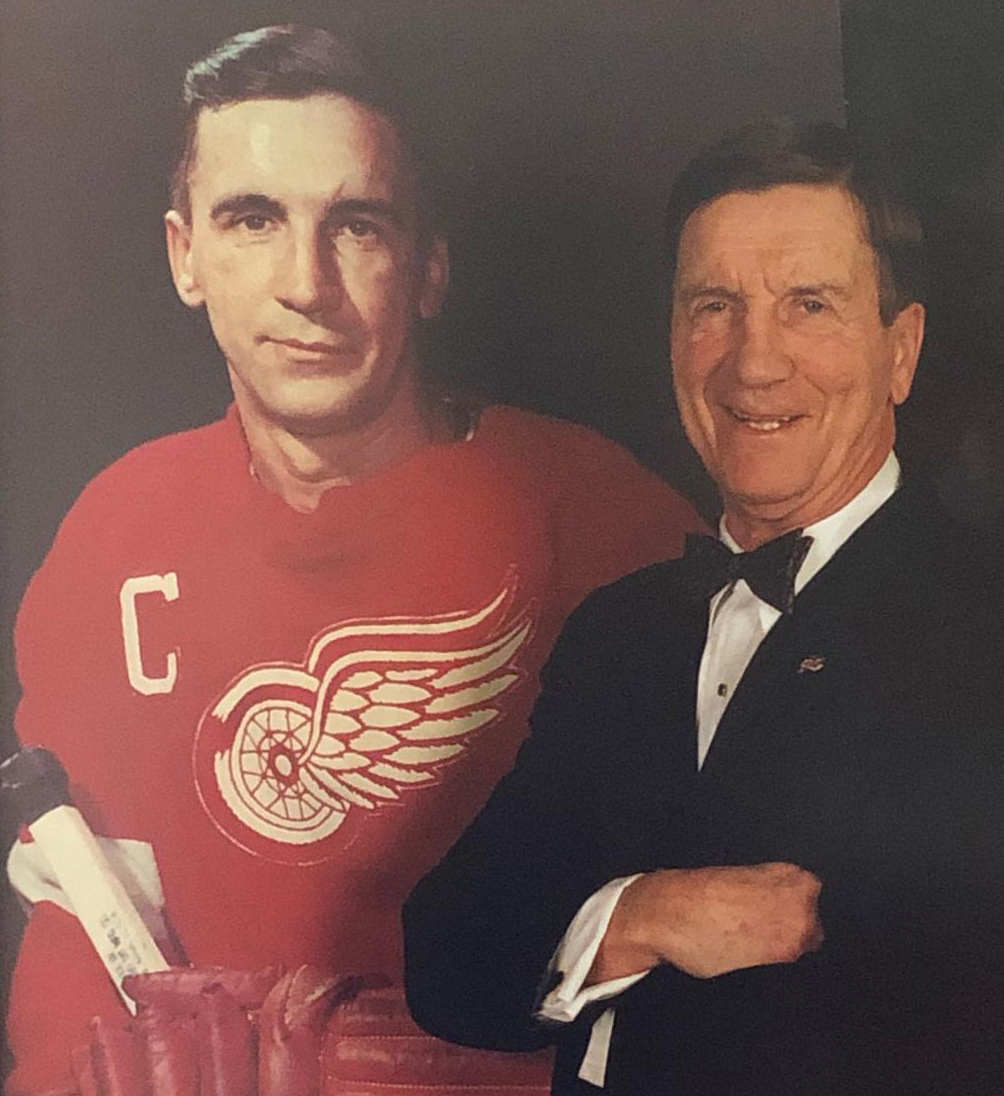 |
| Terrible Ted and Gentleman Ted |
The 2026 Cup Playoffs are around the corner.
Every player in today's NHL owes Ted Lindsay.
Each one should sign over a personal cheque to him at the beginning of this New NHL in recognition for the stance he took on their behalf against the Original Six NHL owners.
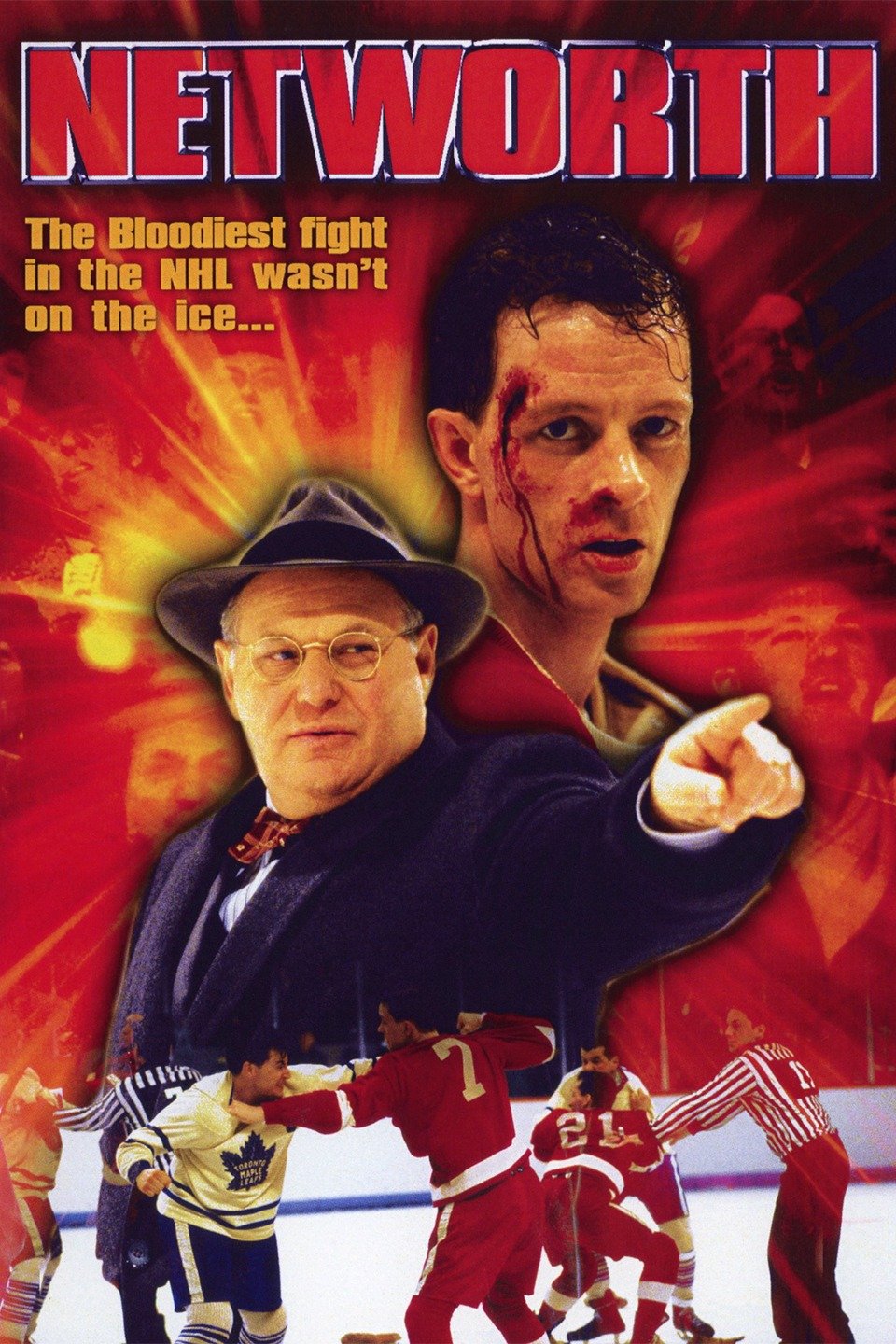 |
| Al Waxman as Adams |
For all players, he demanded better pay and better working conditions. His pioneering work as the architect of the NHLPA was so important that the CBC filmed a movie about his life and the battle he had with team owners.
The movie
It is titled Net Worth.
Incidentally, that money, if Ted were ever to receive it, would go to help others through his Ted Lindsay Foundation, as it provides important research funding for a cure for Autism.
If you're an NHL player today and you earn 3 or 5 or 10 million dollars, it's because of what Lindsay did for you. I wonder how many of today's hockey-playing millionaires even know his name and the part he played in their lives.
His on-ice resume is spectacular and is easily accessed online.
Former 1950s-60's NHL referee, " Red " Storey
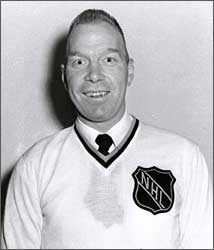 |
| "Red" Storey |
"If I were starting a new franchise, Lindsay would be the player I'd build my team around.
Superstar left-winger Bobby Hull is on record saying
"Ted Lindsay was the best left-winger to ever play the game."
Do you remember the Original Six league?
You know, the league where all the players travelled between
NHL cities by train, not private or chartered planes.
In 2010, the National Hockey League agreed with Storey and Hull.
To recognize the significant impact and improvement Lindsay created for everyone in the game, including better behaviour on the part of team owners, the league renamed its second-most important trophy after him.
The Ted Lindsay Trophy.
It goes to the NHL player who is chosen "Best" by his peers. It's the companion trophy to the Hart Trophy.
Robert Blake Theodore (Ted) Lindsay was born in 1925 in Renfrew, Ontario, Canada, and grew up in Kirkland Lake, Ontario -- an unlikely breeding ground for NHL players. Remarkably, 44 Kirkland Lake boys made it to the NHL from that little mining town.
It's a magical story on its own.
Ted personally tutored three of the town's teenagers: Larry Hillman, Ralph Backstrom, and Dick Duff. He must have been an outstanding teacher since each player distinguished himself by earning 6 Stanley Cups, and Duff joined his mentor as an honoured member of the Hockey Hall of Fame.
He started as a 19-year-old in 1944-45 with the Red Wings
Following his time with the Oshawa Generals
where he'd earned the Memorial Cup.
The Generals were quite a team with future NHL players; (Father) David Bauer, Floyd Curry, Bill Ezinicki, Gus Morston and HHOF honoured member, Charlie Conacher as a coach.
Ted joined the team for their 7-game series against the Trail BC Smoke Eaters.
 |
| At St. Mike's |
He scored 7goals and 2 assists in the 7 games.
Hockey's suits took notice.
Prior to that, he played for Toronto's legendary
St. Michael's Majors, where he scored 22 goals in 22 games.
St. Mike's was the same school that would deliver future NHL players who are also honoured members of the Hockey Hall of Fame; Kelly, Mahovlich, Horton, Keon, Broda, Cheevers, Primeau and the aforementioned Dick Duff.
Remarkably, 90 more of the school's alumni made it to the National League. But going to school was a roadblock for Ted. He knew what he wanted.
Hockey's suits took notice.
Prior to that, he played for Toronto's legendary
St. Michael's Majors, where he scored 22 goals in 22 games.
St. Mike's was the same school that would deliver future NHL players who are also honoured members of the Hockey Hall of Fame; Kelly, Mahovlich, Horton, Keon, Broda, Cheevers, Primeau and the aforementioned Dick Duff.
Remarkably, 90 more of the school's alumni made it to the National League. But going to school was a roadblock for Ted. He knew what he wanted.
His path was clear, and nothing could get in his way. He had an NHL hockey career waiting for him, so he didn't stay at St. Mike's past grade ten.
His lack of formal education proved no barrier when later he'd butt heads with all the owners and managers and the collection of lawyers representing the NHL super-rich owners. They had their hands full with Lindsay. They thought they could bury him. They forgot who they were dealing with.
 |
| Ted Goes to the Black Hawks |
When they were able to measure the fight in him,
they fought back hard. Following his best statistical NHL season, he was traded from his beloved Red Wings to the lowly Chicago Black Hawks, where he'd languish for three years.
When he first joined the 1944 Wings, Ted was a huge fan of his coach, Jack Adams. He quickly learned that Adams, a former NHL player, was a big part of the problem that dumbed down the NHL and mistreated people. Adams just thought players were interchangeable parts and had no regard for them or their families. Ted said,
"He liked that he controlled their lives."
Lindsay was driven to stand up for them and himself against people like Adams.
Lindsay's compassion for his fellow players seemed incongruous.
As a player, he was hated. "Terrible Ted" or "Scarface" was the 5' 8", 163 lbs. monster who played much bigger than his size and earned every one of the 2,000 minutes he spent in the penalty box during his 17-year playing career.
If you doubt his willingness to play outside the lines, the following list shows some of the toughest players to play during the "Original Six" era and their corresponding time in the penalty box: "Red" Horner 1254, Bob Baun 1493, John Ferguson 1214 and the toughest guy, ever, Gordie Howe, 1685 minutes.
Ted Lindsay invented trash-talking. By today's standards, his conduct was totally unequivocally unacceptable.
While playing, he'd use a surname, religion or race. If you weren't as good as you thought you were, you'd be in trouble with Lindsay. He would find that thing about you to get your attention. He would be relentless, he wouldn't stop from the beginning of the game to the end -- anything for an edge. He would grind you, he'd grind everybody. Later in life, he told me he regretted being like that, but frankly, his vicious, unapologetic game-face defined him, and the fans in Detroit loved him for it. If you were a player, you'd want him on your team ... you'd never want to play against him.
One of Ted's primary trash-talking targets was the legendary
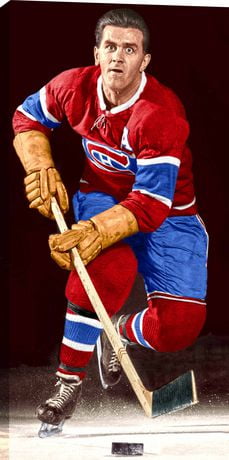 |
| Rocket had "Crazy Eyes" |
In his early playing years, Richard struggled with English. Ted admits to calling him every x-rated name he could think of during a game, with special attention devoted to Rocket's French heritage.
During a game's intermission, Richard would ask teammates what Lindsay was saying to him. When he returned to the ice, he'd be on fire with rage.
Mission accomplished for Lindsay.
Richard would be distracted from the game as he spent his time chasing Ted instead of the puck.
I had some time with "Rocket" during his retirement years.
If he had to use Lindsay's name in a discussion, he couldn't help himself; his face got red, his black eyes lit up, and he could barely mouth the word, Lindsay. And that was 40+ years after they'd faced each other on the ice. Hockey grudges last.
When his wife died, "Rocket" told me the first person to call him and offer his condolences was Lindsay. He said, "We talked about my family and me." "Rocket" was very confused by Ted's thoughtfulness. He'd be further confused to find that Ted's mother was French Canadian.
I'm sending this to you because you are a hockey person. Ted loved hockey people. Loved to be with hockey people and loved to talk about hockey. Just imagine, at his age, he was envious of me because I still played the game he loved so much. "Michael", he'd say ... "did you play today?" "You're so lucky."
"Best game in the world."
I thought you may be interested in some insight into this very special player and person. A player who was so good that he was inducted directly into the Hockey Hall of Fame without the 3-year wait period. A player who didn't attend his own Hall induction because "It was a stag affair and my wife wasn't invited. In my playing days, I was the best husband and the best father ever - as long as we won. Not so much if we lost. I wouldn't have been inducted if it weren't for my wife. If she wasn't invited, I wasn't going."
The following are some Lindsay-isms.
They are not in order or any sequence or category,
Just some things we talked about that came to me
 |
| 7 and 9 |
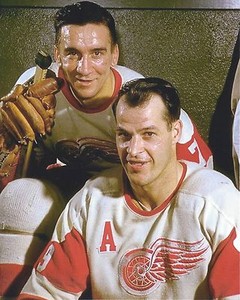
*He thought Gordie Howe was the best player to ever play the game. (Who could disagree, even Gretzky thought Gordie was the best).
However, in my opinion, he would never have become
Mr. Hockey without Lindsay.
(Incidentally, I always wondered what Rocket Richard thought about Howe calling himself "Mr. Hockey").
During games, opposing players would be constantly looking
over their shoulders for Ted while Howe had the puck and was going the other way. Lindsay created lots of room for Howe to operate.
 |
| Jimmy Orlando |
*Through some magical mystery of radio sound wave travel, as a youngster, Ted was able to hear Detroit Red Wing games in his northern Ontario town.
His favourite player was Jimmy Orlando
- a recognized tough-guy with a take-no-prisoners attitude to the game. Ted may have fashioned his game after his hero, but he never admitted to copying anyone.
*I asked him, "How many games did it take for you to feel comfortable in the NHL -- like you belonged?"
He was puzzled by the question.
I rephrased it a couple of times. When he finally understood what I was asking, he may have been a little peeved at my question. He said, "No time ... I knew I belonged in my very first game."
*While creating the NHLPA, he couldn't count on his own players. Red Wing leaders Howe and Kelly "saw no advantage to joining".
Supporting Ted and challenging league ownership
And their mistreatment of players came from an unlikely source: Montreal Canadiens Hall of Fame defenceman Doug Harvey.
*Ted titled the organization the National Hockey League Players' Association because he said the players wouldn't join if he called it a Union.
 |
| Durnan ... "The Best" |
*He played with and against some famous goalies.
He thought Montreal's Bill Durnhan was the best -- Bill
was another kid who made it from Kirkland Lake.
Incidentally, I've played with lots of very good players
over the past 50 years and with Bill Durnhan Jr. for three years. He was one of the best natural players I ever played with; he never saw his dad play.
*The first time he met Alan Eagleson, Lindsay told anyone who'd listen that he was "a crook and a danger to the players".
Nobody listened.
Decades later, after Eagleson had ruined players' lives, he was sent to prison and stripped of all the awards and the hockey recognition he'd stolen over decades. Deservedly, he was dishonourably removed as an inductee to the Hockey Hall of Fame.
*He didn't like today's shoot-ins. He thought the play was "nonsense" and "stifled a player's creativity".
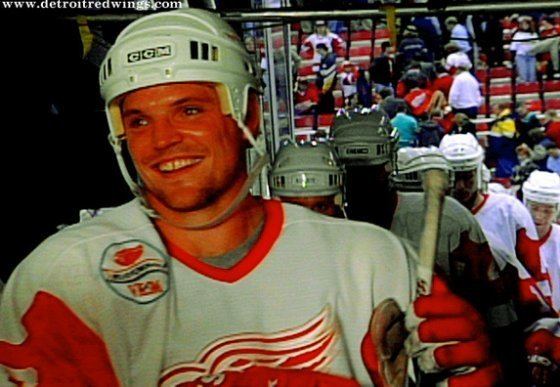
*His favourite Detroit Red Wing in the past 40 years
 |
| His Favourite ... Joe Kocur |
I'd love to have seen him play with Red Wing super-star Igor Larionov.
*He disliked many of the selections for the Hockey Hall of Fame.
He thought it had become too much of a popularity contest instead of a reward for a player's outstanding ability.
If you didn't have a resume like Beliveau, Rocket, Hull, Makita or Kennedy (or him) you shouldn't be in the Hall.
I'll respect his privacy by not revealing his non-deserving list of names.
Ted was very opinionated.
There are a lot of names.
*70 years later, Ted was still very angry with Detroit coach Jack Adams.
"Adams traded away 'Red" Kelly after we'd won 4 Stanley Cups. We would have won more with "Red" ... instead, he went to Toronto to help them win 4."
In February 2019, the Red Wings finally retired Red Kelly's number -- 71 years after he'd joined the Wings. I asked Ted, "What took them so long?" He replied, "It was political."
Hockey grudges last.
*I visited Ted in the beautiful home in Detroit that he and his late wife, Joanne, had built.
When we sat in his kitchen after having dinner at his favourite Italian restaurant, I would go to YouTube and show him a video clip of him in action as a Red Wing.
A goal against the Canadiens ... a fight against a Maple Leaf ... a shouting match with a referee.
He could never quite believe technology. He'd look at the screen and his image as if he were looking at fire for the first time. It was fun for both of us.
*He hated, hated, hated every opponent, but he was very proud to play in their company - especially the "great" ones. He thought Jean Beliveau was "the class of the league". And when he talked about former players, there was always a distinction. He thought many were "great" and always attached that adjective to their name when he was describing them ... "the great Geoffrion" ... "the great Milt Schmidt".
*In December, I asked if he could recount the night that Howe crashed into the boards and almost lost his life. Ted Kennedy was blamed for the incident, and Detroit fans vowed to kill him the next time he played at the Olympia. Lindsay told me there was no TV coverage or radio. The newspaper media fabricated the story, making Kennedy the villain. According to Lindsay, Howe tripped over his own feet, and "nobody was to blame but himself".
When Ted was a teenager, he played hockey for the Holy Name Kirkland Lake juvenile hockey team and played for Ted "Teeder" Kennedy's Port Colborne team for the Ontario Championship.
Imagine two Teds from very rural, tiny Ontario towns eventually becoming captains of their NHL teams and being inducted into the Hockey Hall of Fame in the same year. Maybe it's where famous hockey writer Scott Young (Neil Young's father) got the inspiration to write "Scrubs on Ice".
*If I asked a stupid question, he'd just give me a look, like, "You really didn't just ask me that." Our conversations wouldn't be complete without it. Sometimes I'd manufacture a question just so to get that look. I'd ask him if he ever dyed his hair. That would always guarantee "the look". And, no, he didn't.
*Ted exuded confidence in himself. He claimed that hockey didn't define him ... "I would have been successful at anything I tried."
He was a very religious person and attended mass weekly. He said, "I believe in prayer."
When he arrived at the Pearly Gates, he wouldn't have been asked about his NHL playing career. He'd be the first to admit he was a sinner.
The gates would swing wide open for the man who was generous with his time and support for charities like Special Olympics and Catholic nuns who depended on him to supply desperately needed medical supplies and food to their Third World needy families, and for USA university research labs who are presently using his foundation's $3 million to find the cure for Autism.
Ted Lindsay defined "class" ...
You know ... doing something good for someone else when nobody is looking
If you didn't have a resume like Beliveau, Rocket, Hull, Makita or Kennedy (or him) you shouldn't be in the Hall.
I'll respect his privacy by not revealing his non-deserving list of names.
Ted was very opinionated.
There are a lot of names.
*70 years later, Ted was still very angry with Detroit coach Jack Adams.
"Adams traded away 'Red" Kelly after we'd won 4 Stanley Cups. We would have won more with "Red" ... instead, he went to Toronto to help them win 4."
In February 2019, the Red Wings finally retired Red Kelly's number -- 71 years after he'd joined the Wings. I asked Ted, "What took them so long?" He replied, "It was political."
Hockey grudges last.
*I visited Ted in the beautiful home in Detroit that he and his late wife, Joanne, had built.
When we sat in his kitchen after having dinner at his favourite Italian restaurant, I would go to YouTube and show him a video clip of him in action as a Red Wing.
A goal against the Canadiens ... a fight against a Maple Leaf ... a shouting match with a referee.
He could never quite believe technology. He'd look at the screen and his image as if he were looking at fire for the first time. It was fun for both of us.
*He hated, hated, hated every opponent, but he was very proud to play in their company - especially the "great" ones. He thought Jean Beliveau was "the class of the league". And when he talked about former players, there was always a distinction. He thought many were "great" and always attached that adjective to their name when he was describing them ... "the great Geoffrion" ... "the great Milt Schmidt".
*In December, I asked if he could recount the night that Howe crashed into the boards and almost lost his life. Ted Kennedy was blamed for the incident, and Detroit fans vowed to kill him the next time he played at the Olympia. Lindsay told me there was no TV coverage or radio. The newspaper media fabricated the story, making Kennedy the villain. According to Lindsay, Howe tripped over his own feet, and "nobody was to blame but himself".
When Ted was a teenager, he played hockey for the Holy Name Kirkland Lake juvenile hockey team and played for Ted "Teeder" Kennedy's Port Colborne team for the Ontario Championship.
Imagine two Teds from very rural, tiny Ontario towns eventually becoming captains of their NHL teams and being inducted into the Hockey Hall of Fame in the same year. Maybe it's where famous hockey writer Scott Young (Neil Young's father) got the inspiration to write "Scrubs on Ice".
*If I asked a stupid question, he'd just give me a look, like, "You really didn't just ask me that." Our conversations wouldn't be complete without it. Sometimes I'd manufacture a question just so to get that look. I'd ask him if he ever dyed his hair. That would always guarantee "the look". And, no, he didn't.
*Ted exuded confidence in himself. He claimed that hockey didn't define him ... "I would have been successful at anything I tried."
He was a very religious person and attended mass weekly. He said, "I believe in prayer."
When he arrived at the Pearly Gates, he wouldn't have been asked about his NHL playing career. He'd be the first to admit he was a sinner.
The gates would swing wide open for the man who was generous with his time and support for charities like Special Olympics and Catholic nuns who depended on him to supply desperately needed medical supplies and food to their Third World needy families, and for USA university research labs who are presently using his foundation's $3 million to find the cure for Autism.
Ted Lindsay defined "class" ...
You know ... doing something good for someone else when nobody is looking
 |
| The Introduction of the very first Ted Lindsay Trophy was at the NHL Players Awards in Las Vegas NV in 2006 The first recipient was Sidney Crosby |
My childhood idol is gone.
As a youngster, I wanted to be him.
As an adult, I met someone who was a wonderful stroke of luck for me and formed a 30-year-long friendship. It was such an honor for me to be the one who presented Ted Lindsay for induction into Canada's Sports Hall of Fame.
He was inducted in 2002.
I miss him. Today is his birthdate; he would have been 95. He passed away in Mar. 2019.
I hope you've enjoyed my reminiscences of Ted. But, perhaps the only thing you really need to know about the man isn't about hockey, it's found in the way he finished every one of our conversations.
He'd say, "Michael, please give my very best wishes to your wife, Lorraine."
Always a gentleman, always considerate of others, always principled, always sweet and generous,... just not on the ice.
Hi Michael … thanks for this excellent scribing and reminder of our KL hockey past..
ReplyDeleteI played on a line with Larry Hillman against teams with Dick Duff and Ralph Backstrom…. Public School hockey in the ‘50s.
So my memories go deep..
I spoke to Dick at his home before he moved to a seniors residence .. we had a good chat….thanks to you..
All the best..